
General Information
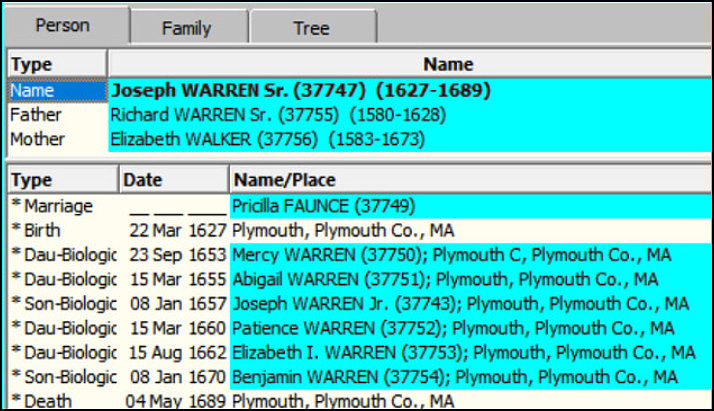
Consider yourself as the starting point. Looking forward, your history (legacy) touches your children, grandchildren, great-grandchildren, etc. Looking back, your history includes parents, grandparents, great -grandparents, aunts, uncles, etc. as far back as can be traced. Most folks explore their histories to know more about extended families. The following illustration is an example of family history style information for an individual.
The numbers in parentheses following a name are identification numbers. ID numbers strictly refer to a person. There is no "coded" significance. The Type column is the event type for major events in a person's life. In birth events, a relationship is established to the Named individual . The Date column contains what we know about the event date. The date could be an approximation, year, month or complete. Note the date format is totally unambiguous. Place information may include city, county, state, and country. The illustration shows states abbreviated and country is assumed to be USA unless otherwise noted.
Expectations
Documenting a family history is a complex process. Detailing a history is solving a large puzzle. The process is iterative. For example, information about parents is sometimes found while researching their children. It's normal to work back and forth between people in the history as new facts surface. The more you know the more you find. For an individual's information may only be a name, date of birth, and State where born. Knowing the parents names may lead from an approximate birth date to the actual day, month and year. Consequently, dates and location of other events may emerge. Accuracy is always an issue. Government records are the most accurate but don't always agree. Semi-official records (e.g., burial information) are less accurate. And other people's family histories are down right suspect unless they agree with your independent findings.
There will always be some errors in your data. The errors may come from your source data. So when some well-meaning soul offers a correction, thank them!
Perspective
A family history contains dates, people, places, relationships and details about significant events in a person's life. Much research effort goes into evaluating search results for applicability. It's helpful to consider a lifetime as a timeline. Events must occur on a person's timeline. If your family history software displays events in chronological order you have a timeline. Without a software chronology try to keep a person's timeline in mind as you evaluate search findings.
Birth, burial, death, and marriage records frequently identify other family members. Without a link to a known family menber it's difficult/impossible to know if the information in question applies to your person of interest.
Often event information provides additional detail such as a middle name rather than an initial. Be sure to add each new detail right away. A new detail may allow you to add new events. Repeat analysis of search results as additional details are found. The process is iterative. Continue sifting search results as long as new details emerge.
Consider yourself as the starting point. Looking forward, your history (legacy) touches your children, grandchildren, great-grandchildren, etc. Looking back, your history includes parents, grandparents, great -grandparents, aunts, uncles, etc. as far back as can be traced. Most folks explore their histories to know more about extended families. The following illustration is an example of family history style information for an individual.
The numbers in parentheses following a name are identification numbers. ID numbers strictly refer to a person. There is no "coded" significance. The Type column is the event type for major events in a person's life. In birth events, a relationship is established to the Named individual . The Date column contains what we know about the event date. The date could be an approximation, year, month or complete. Note the date format is totally unambiguous. Place information may include city, county, state, and country. The illustration shows states abbreviated and country is assumed to be USA unless otherwise noted.
Expectations
Documenting a family history is a complex process. Detailing a history is solving a large puzzle. The process is iterative. For example, information about parents is sometimes found while researching their children. It's normal to work back and forth between people in the history as new facts surface. The more you know the more you find. For an individual's information may only be a name, date of birth, and State where born. Knowing the parents names may lead from an approximate birth date to the actual day, month and year. Consequently, dates and location of other events may emerge. Accuracy is always an issue. Government records are the most accurate but don't always agree. Semi-official records (e.g., burial information) are less accurate. And other people's family histories are down right suspect unless they agree with your independent findings.
There will always be some errors in your data. The errors may come from your source data. So when some well-meaning soul offers a correction, thank them!
Perspective
A family history contains dates, people, places, relationships and details about significant events in a person's life. Much research effort goes into evaluating search results for applicability. It's helpful to consider a lifetime as a timeline. Events must occur on a person's timeline. If your family history software displays events in chronological order you have a timeline. Without a software chronology try to keep a person's timeline in mind as you evaluate search findings.
Birth, burial, death, and marriage records frequently identify other family members. Without a link to a known family menber it's difficult/impossible to know if the information in question applies to your person of interest.
Often event information provides additional detail such as a middle name rather than an initial. Be sure to add each new detail right away. A new detail may allow you to add new events. Repeat analysis of search results as additional details are found. The process is iterative. Continue sifting search results as long as new details emerge.